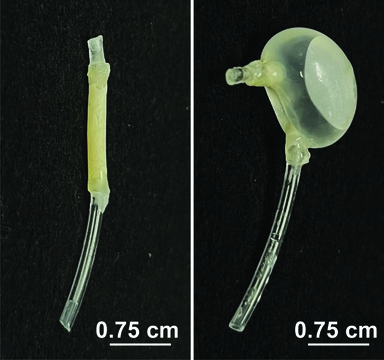
University of Iowa Health Care researchers have developed a tiny drug-delivery device that could offer patients with bladder cancer a less invasive and less time-consuming way to receive treatment. The device, which is about the size of a dime, floats in the bladder and slowly delivers one half of a dual chemotherapy drug combination that is used to treat non-muscle-invasive bladder cancer (NMIBC). The patient would not need to remain in the clinic during this part of the treatment and could remove the device themselves once the treatment was complete.
Currently, the two-drug regimen for NMIBC requires invasive procedures to deliver both drugs, gemcitabine and docetaxel (gem/doce), sequentially into the bladder. The procedure is time-intensive for both the patient and clinicians administering it. There is a two-hour wait between the administration of the two drugs and patients spend up to four hours per session in the outpatient clinic with limited mobility during treatment. These constraints can make it hard for some patients to adhere to the treatment.
James Byrne, MD, PhD, UI assistant professor of radiation oncology, and his team designed the DRIFT (Drug-Releasing Intravesical Floating Technology) device with the goal of improving the care experience for patients receiving the gem/doce regimen, which was also pioneered at UI Health Care.
“Our hope is that this simple device could transform the patient experience,” says Byrne, who is also a member of UI Health Care Holden Comprehensive Cancer Center. “For patients receiving repeated treatments, it could reduce the time of clinic visits and the discomfort of invasive procedures.”
Simple device could improve bladder cancer care
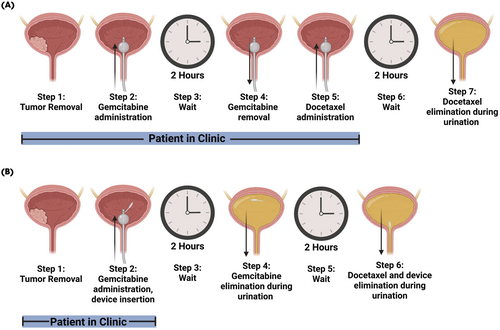
The DRIFT device is a small, flexible, 3D-printed tube that holds the docetaxel chemotherapy drug. It is easily placed into the bladder through a standard foley catheter, and it floats freely in the bladder without causing any obstruction. The device’s coated end-cap dissolves slowly to release the docetaxel on a controlled schedule so that the drug is delivered into the bladder after the gemcitabine has had its effect and been urinated out.
After the device is inserted in the clinic, the patient would be free to go about their normal daily activities. When the treatment is finished, several hours later, the device could be removed by the patient at home via a small string attached to the device.
“We are excited that this device could transform our patients’ experiences of receiving this very effective but very time-intensive therapy,” Byrne says. “Creating a technology that allows patients to spend less time in the clinic, with less invasive procedures, could improve quality of life for people undergoing treatment for bladder cancer.”
Byrne and his team have tested the effectiveness of the DRIFT device in large animal models and demonstrated that it reliably contains the docetaxel chemotherapy during the two-hour gemcitabine pre-treatment period before releasing the docetaxel into the bladder. The study, which was published recently in the journal BJU International (BJUI), also showed that the buoyant design and structural flexibility of the DRIFT device effectively prevented obstruction of the urethra, allowing for continuous urine flow during treatment.
The next step for the research team will be to perform pharmacokinetic and safety studies in large animals before eventually moving on to clinical trials in humans.
Creating a technology that allows patients to spend less time in the clinic, with less invasive procedures, could improve quality of life for people undergoing treatment for bladder cancer - James Byrne, MD, PhD
While the DRIFT device is currently only being tested with the gem/doce regimen, the researchers believe the technology may also be useful for improving treatment of other bladder conditions, such as interstitial cystitis/bladder pain syndrome, recurrent urinary tract infections, and radiation cystitis.
In addition to Byrne, UI researchers Kaitlyn McClintic, Emily Witt, Ikenna Nwosu, Kyle Balk, Colin Reis, Ian Sutton, and Michael A. O’Donnell, were also involved in the work. The team also included Ashley Rhodes at Duke University; Jianling Bi at Chongqing Medical University in China; and Melinda Fu and Vignesh Packiam at Rutgers Cancer Institute.
The research was funded in part by grants from the National Cancer Institute and the American Cancer Society.
Rhodes, Witt, Packiam, and Byrne have filed a provisional patent related to the DRIFT device.
Bladder cancer is one of the most common cancers in the U.S. The DRIFT device could help the 75% of patients who are diagnosed with early-stage disease, known as non-muscle-invasive bladder cancer (NMIBC), which is usually highly treatable, but current treatment can be time intensive and invasive.