
James D. Byrne, MD, PhD, knows his research may sound far-fetched to some.
“Imagine sipping your medication off the top of your latte or hot chocolate. This idea is not science fiction,” he writes in the opening for his prize essay in Science.
Byrne, an assistant professor of radiation oncology with University of Iowa Health Care, was named one of two finalists for the 2026 BioInnovation Institute & Science Prize for Innovation. The prize recognizes outstanding researchers working at the intersection of life sciences and entrepreneurship, with an emphasis on translating scientific discoveries into practical applications.
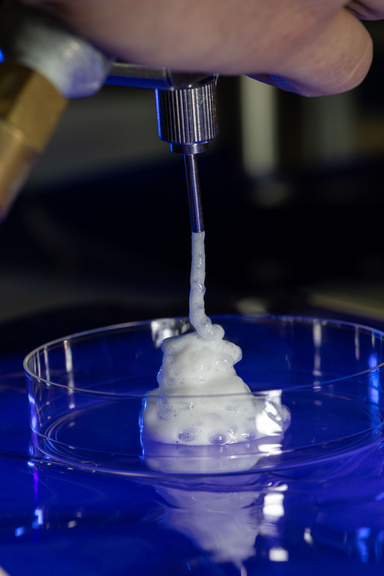
Byrne’s prize-winning essay was published in Science on April 2 and highlights his work developing gas-entrapping materials (GEMs), a platform designed to deliver therapeutic gases in new ways. He will also receive a $10,000 cash prize in Copenhagen on April 14.
Byrne’s research focuses on using GEMs to address challenges in areas like inflammation, wound healing, and cancer treatment. His work shows how gases such as carbon monoxide and oxygen can be delivered safely to improve outcomes, including accelerating wound healing and enhancing responses to cancer therapies. His research also includes early-stage clinical translation and efforts to move GEM-based therapies closer to patient use.
Read Byrne’s full essay on Science's website, or learn more about his work in our previous Medicine Iowa feature.
About James D. Byrne
James D. Byrne received a bachelor's degree in biomedical engineering from the University of Texas and a medical degree and doctoral degree from the University of North Carolina. After completing his residency in radiation oncology at the Harvard Radiation Oncology Program and postdoctoral fellowship training at the Massachusetts Institute of Technology, he started his laboratory in the Department of Radiation Oncology at the University of Iowa in 2021. His laboratory focuses on translational engineering to develop technologies that improve cancer therapies and reduce treatment burden for patients.